
Analysts mostly prefer domestic plays beside select films with foreign exposure.

With cash -- the primary medium of exchange -- all but disappearing, it is now unlikely that the expected fillip to demand on account of a good monsoon and proceeds from the Seventh Pay Commission payout will materialise.

Corporate India at present is more indebted than all state govts put together.

Nifty 50 firms' net profit estimated to grow by a modest 3.1% in Q2, reports Krishna Kant.

From its all-time peak of 38,989.65 scaled on August 29 this year, the Sensex has fallen by 2,921.32 points, or 7.5 per cent, to 36,068.33.

Kotak Bank was the top gainer in the Sensex pack, ending 4.31 per cent higher. PowerGrid, TCS, ICICI Bank, SBI, HCL Tech, NTPC, Infosys, Bajaj Finance, HDFC duo, ONGC, Vedanta and IndusInd Bank too rose up to 2.84 per cent.

Fresh investments by corporates up just 5.8% in FY17, lowest since 1992

Infosys' aspirations to improve revenue per employee might also prove to be a tall task, believe analysts.

For equity investors, the risk-to-reward ratio is worsening.

Equity benchmark Sensex tumbled 674 points on Friday, weighed by losses in banking stocks as an unabated spike in new coronavirus cases fuelled uncertainty over the economic impact of the pandemic. After hitting a low of 27,500.79 during the day, the 30-share BSE barometer ended 674.36 points or 2.39 per cent lower at 27,590.95. The NSE Nifty shed 170 points, or 2.06 per cent, to finish at 8,083.80.

Sales expansion also down 4.4%

The ruling BJP losing Chhattisgarh, Madhya Pradesh and Rajasthan, or being able to retain power only in Chhattisgarh may result in a "sharp correction" in the indices

A full-blown recovery remained elusive for India Inc in the July-September quarter, even as it overcame the challenge of achieving profitable growth.

'The government is encouraging consumption through fiscal spending in a bid to push up economic growth in the face of a slowdown in corporate investment and exports.'

Over the past four quarters, the Sensex companies' earnings trajectory has improved sharply because of a weak rupee.
Top losers in the Sensex pack included ICICI Bank, Tata Steel, Vedanta, HDFC IndusInd Bank, Tata Motors, RIL and ONGC -- falling up to 4.45 per cent.

In the Sensex pack, Axis Bank, Tata Motors, Infosys, Kotak Bank, HDFC Bank, RIL, Bajaj Auto, SBI, HUL, Tata Steel, Vedanta, HFDC, TCS, ITC and Sun Pharma jumped up to 4.64 per cent.


This was even as the country's economy grew by 7.3%.

A weak rupee, though seemingly good for exporters, would push up input cost further for Indian companies.
In the Sensex kitty, ITC turned star performer by surging 2.45 per cent, followed by NTPC rising 2.19 per cent.

The sharp fall in the rupee's value against the dollar during the July-September quarter, it turns out, has come as a boon for corporate earnings.
.jpg)
Revenue yield on every rupee of investment fell to Rs 1.06 in FY13 from Rs 1.20 in FY08.
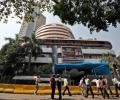
Stock prices is due to valuation expansion

All sectoral indices on the BSE and NSE ended in the red, led by realty, banking, metal, pharma, pharma and financial stocks.

The fall was led by L&T, IndusInd Bank, PowerGrid, NTPC, TCS, ICICI Bank, Axis Bank, Hero MotoCorp, Bharti Airtel and SBI, declining up to 2.64 per cent.

If you are not happy with the price offered at buybacks, you could be in for a long haul.

Chinese telcos hold 60-100 MHz of spectrum, while Indian companies hold 13-15 MHz of spectrum.
Net profit grew 25.4% in Q4 but revenue growth, lower at 8.5%, suggests lack of volume expansion.

Companies from the capital goods space will under-perform.
Among Sensex constituents, HCL Tech suffered the most by diving 2.26 per cent, followed by HDFC shedding 2.10 per cent.

Among Sensex components, shares of Reliance Industries, India's largest company by market value, stole the show by surging 1.61 per cent to their highest in over three months.

Gold is currently trading at Rs 25,200 for 10 grams.
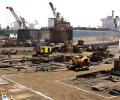
Adani Enterprises plans to invest a total of $25 billion in the next five years.

India Inc did not perform well during December quarter.
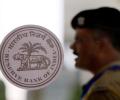
The windfall from RBI may be used to trim borrowing, help fund Rs 3.3 lakh crore capex plan, capitalise banks and provide fiscal stimulus to some stressed sectors, experts and economists said.

Analysts remain confident RIL's refining and petrochemical segment will continue to support growth.

And why markets could give up 25 per cent of all these gains made since March 2020

Large-cap scrips are still trading at a discount to mid-caps.
.jpg)
Investors often forget that the movements in indices such as the Sensex reflects the performance of its constituent stocks; nothing else.
